Skip to content

Marmots are large ground squirrels that live in different parts of North America. They are known for their thick fur, strong bodies, short legs, and long winter sleep. Most marmots live in mountain areas, but some species live in open fields and other habitats.
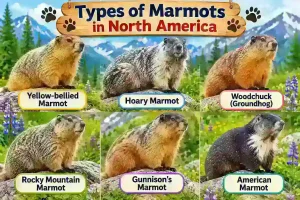
There are six commonly recognized types of marmots in North America. These include the Hoary Marmot, Yellow-Bellied Marmot, Olympic Marmot, Vancouver Island Marmot, Alaska Marmot, and Groundhog.
Each species has its own look, habitat, and way of life. Some live in cold mountain regions, while others live in forests and grassy areas.
This guide explains the types of marmots in North America, where they live, what they eat, and how to identify them. It also covers their behavior, hibernation, predators, and the difference between a marmot and a groundhog.
How Many Types of Marmots Are in North America?

There are six commonly recognized marmot species in North America. They belong to the genus Marmota and are members of the squirrel family.
Here is the list of marmots found in North America:
- Hoary Marmot (Marmota caligata)
- Yellow-Bellied Marmot (Marmota flaviventris)
- Olympic Marmot (Marmota olympus)
- Vancouver Island Marmot (Marmota vancouverensis)
- Alaska Marmot (Marmota broweri)
- Groundhog or Woodchuck (Marmota monax)
Most North American marmots live in the western part of the continent. The Groundhog is different because it mainly lives in the eastern and central parts of North America.
These six species have different fur colors, body sizes, and habitats. Learning about each one makes it easier to understand the marmots of North America.
Hoary Marmot
The Hoary Marmot (Marmota caligata) is a large mountain marmot found in western North America. It lives in Alaska, Canada, and parts of the northwestern United States.
This marmot has thick gray or brown fur. Its shoulders and upper back may look pale or frosted, which gives it the name hoary. It has a strong body, short legs, and a bushy tail.
Hoary Marmots often live near rocky slopes, mountain meadows, and large piles of stones. These places give them safe areas to hide from predators.
They eat grasses, flowers, leaves, roots, and other green plants. During summer, they eat more food to build body fat for winter.
Hoary Marmots also use loud warning calls when they see danger. These sounds help other marmots know when a predator is nearby.
Yellow-Bellied Marmot
The Yellow-Bellied Marmot (Marmota flaviventris) is another common species in western North America.
It gets its name from the yellow or golden color of its belly. Its back is usually brown, and it may have darker fur around the head and face.
This marmot lives in the western United States and parts of Canada. It prefers rocky mountain areas, open slopes, and grassy places.
Yellow-Bellied Marmots eat grass, wild flowers, leaves, seeds, and other plants.
This species spends much of the warmer season eating and preparing for winter hibernation.
Olympic Marmot
The Olympic Marmot (Marmota olympus) is a special marmot found only in the Olympic Mountains of Washington State.
It has brown fur, a strong body, and a thick tail. Its fur may become lighter or darker as the seasons change.
Olympic Marmots live in mountain meadows and rocky areas. They often build burrows in places where they can find food and stay safe.
Their diet includes grasses, flowers, leaves, and other mountain plants. They spend the warmer months eating and storing fat.
This species is known for its social behavior and warning calls. When one marmot notices danger, it can alert others nearby.
The Olympic Marmot has a very limited natural range because it lives in one main mountain region. This makes its habitat important for its long-term survival.
Vancouver Island Marmot
The Vancouver Island Marmot (Marmota vancouverensis) is one of the rarest marmots in North America.
It lives only on Vancouver Island in British Columbia, Canada. This means it is an endemic species, which means it naturally lives in one particular place.
It has dark brown or chocolate-colored fur. White markings may appear around its nose, chin, forehead, and chest. Young marmots often have very dark fur.
Vancouver Island Marmots live in high mountain areas with open meadows. They use underground burrows for shelter and winter sleep.
They eat grasses, leaves, flowers, and other green plants. Like other marmots, they build body fat before hibernation.
This species is highly social and uses different sounds to communicate. It has faced serious population problems, so wildlife groups work to protect it.
Conservation programs include captive breeding, habitat protection, and the release of marmots into suitable natural areas.
Alaska Marmot
The Alaska Marmot (Marmota broweri) is also known as the Brooks Range Marmot or Arctic Marmot.
It lives in northern Alaska, especially in rocky mountain areas of the Brooks Range.
This species has thick fur that helps it survive in cold places. Its body is strong, and its claws help it dig burrows among rocks and soil.
Alaska Marmots eat grasses, flowers, roots, and other plants that grow in their cold mountain habitat.
They spend a large part of the year in hibernation because winters in northern Alaska are very long and cold.
Their underground burrows protect them from harsh weather and help them survive when food is difficult to find.
Groundhog or Woodchuck

The Groundhog (Marmota monax) is also called a Woodchuck or Whistle Pig. It is one of the best-known marmots in North America.
Unlike most North American mountain marmots, the Groundhog mainly lives in eastern and central parts of the continent.
It can be found in forests, fields, gardens, farms, and areas near roads. It often digs large underground burrows with several openings.
Groundhogs have brown or gray-brown fur, short legs, and strong front claws. They use their claws and teeth to dig and eat plants.
Their diet includes grass, leaves, flowers, fruits, vegetables, and garden plants.
Groundhogs are mostly solitary animals. They spend much of their time searching for food and staying near their burrows.
They are also true hibernators. Before winter, they eat more food and store fat in their bodies.
Marmot Scientific Classification
Marmots belong to the animal kingdom and are part of the squirrel family. They are rodents, which means they have strong front teeth that continue to grow throughout their lives.
Their scientific classification is:
- Kingdom: Animalia
- Phylum: Chordata
- Class: Mammalia
- Order: Rodentia
- Family: Sciuridae
- Tribe: Marmotini
- Genus: Marmota
The genus Marmota includes marmots found in North America, Europe, and Asia.
Scientists divide marmots into two main subgenera: Petromarmota and Marmota. This classification helps explain how different marmot species are related.
What Is Petromarmota?
Petromarmota is a scientific subgenus of marmots. It includes four North American mountain species.
These species are:
- Hoary Marmot
- Yellow-Bellied Marmot
- Olympic Marmot
- Vancouver Island Marmot
These four species are closely related and mainly live in western North America.
The Alaska Marmot and Groundhog are also members of the genus Marmota, but they do not belong to the subgenus Petromarmota.
This difference is useful when learning about marmot species and their scientific relationships.
How to Identify Different Marmot Species
You can identify marmots by looking at their fur color, body shape, size, and natural habitat.
The Hoary Marmot often has gray or frosted-looking fur. It is usually found in rocky mountain areas.
The Yellow-Bellied Marmot has a yellow-colored belly and brown fur. It lives in western mountain regions.
The Olympic Marmot is found only in the Olympic Mountains of Washington. Its location is one of the easiest ways to identify it.
The Vancouver Island Marmot has dark chocolate-brown fur with white markings on its face and chest. It lives only on Vancouver Island.
The Alaska Marmot lives in northern Alaska and has thick fur for cold weather.
The Groundhog has brown fur and is commonly found in fields, gardens, and forests in eastern North America.
When looking at types of marmots in North America pictures, check the animal’s body color, face markings, and location. These clues can help you tell one species from another.
Marmot Size and Weight Comparison
Marmots are among the largest members of the ground squirrel family. Their size and weight depend on their species, age, sex, and the time of year.
| Marmot species | General size or appearance |
| Hoary Marmot | Large, thick-bodied mountain marmot |
| Yellow-Bellied Marmot | Medium to large body with yellow belly |
| Olympic Marmot | Strong body with brown fur |
| Vancouver Island Marmot | Large body with dark brown fur |
| Alaska Marmot | Stocky body with thick fur |
| Groundhog | Large ground squirrel with brown fur |
Marmots often gain weight during summer because they need stored fat for winter hibernation. They lose much of this stored energy while sleeping through the cold season.
Where Do Marmots Live in North America?

Marmots live in different habitats across North America. Most species prefer mountain areas with rocks, grass, and open spaces.
Their habitats include:
- Alpine meadows
- Subalpine meadows
- Rocky mountain slopes
- Boulder fields
- Talus slopes
- Grasslands
- Forest edges
- Open fields
Rocky areas are important because marmots use them for shelter and protection. They often dig burrows under rocks or in soil near their feeding areas.
The western United States and Canada are home to several mountain marmot species. Groundhogs live in many eastern and central regions.
Where Do Marmots Live in the US?
Several marmot species live in the United States.
Hoary Marmots can be found in Alaska and parts of the northwestern United States. Yellow-Bellied Marmots live in many western states.
Olympic Marmots are found only in Washington’s Olympic Mountains. Alaska Marmots live in northern Alaska.
Groundhogs have a much wider range in the eastern and central United States. They can live in forests, farms, fields, and gardens.
The exact location depends on the species and its habitat needs.
Marmot Distribution Across North America
Marmot species are not spread evenly across North America.
Western mountain regions are home to most of the mountain marmots. These include Alaska, western Canada, Washington, and other parts of the western United States.
The Vancouver Island Marmot has a very small natural range on Vancouver Island. The Olympic Marmot is limited to the Olympic Mountains.
The Groundhog has a wider range across eastern and central North America.
These different ranges show how marmots have adapted to many types of environments.
What Do Marmots Eat?
Marmots are mostly herbivores, which means they mainly eat plants. Their diet changes depending on the plants available in their habitat.
Common foods include:
- Fresh grass
- Wild flowers
- Green leaves
- Roots
- Seeds
- Berries
- Small plants
- Mosses
- Lichens
Marmots spend many hours eating during the warmer months. This helps them build body fat before winter.
What Do Different Marmot Species Eat?
Different marmot species eat plants that grow near their homes.
Hoary Marmots eat grasses, flowers, leaves, roots, and berries.
Yellow-Bellied Marmots feed on grass, wild flowers, seeds, and green plants.
Olympic Marmots eat mountain meadow plants, flowers, and leaves.
Vancouver Island Marmots feed on grasses, flowers, and other plants found in mountain meadows.
Alaska Marmots eat grasses, flowers, roots, mosses, and lichens.
Groundhogs eat grass, leaves, fruits, vegetables, flowers, and garden plants.
Do Marmots Eat Meat?
Marmots are mainly plant-eating animals. They do not normally hunt other animals for food.
Plants provide most of the energy they need. Their diet may sometimes include insects or other animal matter, but this is not their main food source.
How Do Marmots Find Food?
Marmots search for food near their burrows. They use their front teeth to bite plants and their paws to hold food.
They often feed in open areas where they can watch for danger. If they notice a predator, they may make a warning call and run back to their burrow.
Why Do Marmots Eat More Before Winter?
Marmots eat a lot during summer because they need to build body fat before hibernation.
During winter, they stay inside underground burrows and do not search for regular food. Their bodies use stored fat for energy.
This natural eating habit helps them survive long and cold winters.
Do Marmots Drink Water?
Marmots get some of their water from fresh plants and other foods. They may also drink from natural water sources when available.
Their water needs depend on their food, weather, and habitat.
Marmot Behavior and Adaptations

Marmots have special habits that help them survive in different environments.
Hibernation
Hibernation is one of the most important parts of a marmot’s life.
During winter, marmots stay inside their underground burrows. Their body temperature, heart rate, and breathing slow down.
They use stored body fat for energy while they sleep.
Before winter begins, they eat more food to prepare for this long period without regular feeding.
Burrowing
Marmots dig underground homes called burrows. These burrows give them shelter from bad weather and predators.
Some burrows have several openings and tunnels. Marmots may use different parts of the burrow for resting, sleeping, and raising young.
Thick Fur and Body Fat
Marmots have thick fur that helps protect them from cold weather. Their stored body fat gives them energy during hibernation.
These features help them live in mountain regions where temperatures can become very low.
Strong Claws and Teeth
Marmots have strong front claws that help them dig. Their large front teeth help them bite plants and other food.
These body features are useful for daily life in rocky and grassy habitats.
How Do Marmots Communicate?
Marmots use sounds and body movements to communicate with each other.
One common sound is a warning whistle. When a marmot sees a predator, it may make a loud call to warn nearby animals.
Other marmots may then run toward their burrows or hide among rocks.
Marmots also use different calls during social activities. These sounds help them stay aware of other animals in their group.
Some species, such as the Vancouver Island Marmot, have special vocal sounds that help scientists study their behavior.
Do Marmots Live Alone or in Groups?
Marmot social behavior depends on the species.
Some marmots live mostly alone, while others form groups or colonies.
Groundhogs are often solitary animals. They usually spend much of their time in their own burrows.
Mountain marmots may live in family groups or colonies. They can share areas for feeding, resting, and raising young.
Living near other marmots can help them notice danger. Their warning calls allow nearby animals to react quickly.
What Animals Hunt Marmots?
Marmots have several natural predators. These animals may hunt them when they leave their burrows to find food.
Common marmot predators include:
- Wolves
- Coyotes
- Foxes
- Bears
- Golden Eagles
- Other large birds of prey
- Weasels
The type of predator depends on the marmot’s location.
Marmots use rocks, underground burrows, and warning calls to stay safe. They often watch their surroundings while feeding in open areas.
Marmot Life Cycle and Reproduction
Marmots usually mate after coming out of winter hibernation.
After mating, the female gives birth to a small group of babies. Baby marmots are often called pups.
The pups are born inside underground burrows. They are small and depend on their mother for food and protection.
As they grow, they begin to leave the burrow and explore the area. They learn how to find food and respond to danger.
Young marmots need time to grow before they can live independently.
The exact breeding season, number of young, and age of maturity can differ between species.
Which North American Marmots Are Endangered?
Not all North American marmots have the same conservation status.
The Vancouver Island Marmot is one of the most threatened marmot species. It has a very limited natural range and has faced serious population declines.
Wildlife conservation programs help protect this species through breeding, habitat care, monitoring, and reintroduction.
The Olympic Marmot also has a limited range. Changes in its mountain habitat and other environmental pressures can affect its population.
Other marmot species have wider ranges, but they still need healthy habitats to survive.
Conservation work helps protect mountain meadows, natural burrows, and the plants that marmots eat.
When Do Marmots Come Out of Hibernation?

Marmots usually come out of hibernation during spring.
The exact time depends on the species, weather, location, and local conditions.
In warmer areas, marmots may become active earlier. In colder mountain regions, they may stay underground longer.
After waking up, marmots search for fresh plants and begin preparing for the breeding season.
They also need to replace the body fat they lost during winter.
Marmot vs Groundhog: What’s the Difference?
A Groundhog is a type of marmot. Its scientific name is Marmota monax.
The word marmot refers to the larger group of animals in the genus Marmota. Groundhog is the common name for one species in that group.
Here are some simple differences:
| Feature | Marmot | Groundhog |
| Meaning | A group of related species | One marmot species |
| Scientific name | Marmota | Marmota monax |
| Habitat | Many mountain and open habitats | Fields, forests, and gardens |
| Range | North America, Europe, and Asia | Eastern and central North America |
| Fur | Different colors by species | Usually brown or gray-brown |
| Behavior | Depends on species | Often lives alone |
So, all groundhogs are marmots, but not all marmots are groundhogs.
Marmot vs Ground Squirrel
Marmots and ground squirrels belong to the same squirrel family, Sciuridae.
However, marmots are usually larger and heavier than many other ground squirrels.
Marmots often live in mountain areas and spend a long time in winter hibernation. Other ground squirrels may live in grasslands, deserts, or open fields.
Both animals can dig burrows and use warning calls to stay safe.
Are Marmots Dangerous?
Marmots are usually shy animals and try to avoid people.
They are not normally dangerous when left alone. However, they are wild animals and may bite or scratch if they feel trapped or threatened.
It is best to watch marmots from a safe distance. Do not try to touch, feed, or catch them.
Keep pets away from wild marmots, and never block the entrance to their burrows.
Are There Marmots in North Carolina?
Yes, there are marmots in North Carolina.
The Groundhog (Marmota monax) lives in North Carolina and other eastern parts of the United States.
It can be found in open fields, forest edges, farms, and areas near gardens.
People may also call this animal a Woodchuck or Whistle Pig.
Are Marmots in Pakistan?
Yes, marmots are found in Pakistan, but they are not the same species as the North American marmots.
Two examples are the Long-Tailed Marmot (Marmota caudata) and the Himalayan Marmot (Marmota himalayana).
These species live in high mountain regions of Asia. The Long-Tailed Marmot is found in parts of northern Pakistan, including mountain areas around the Deosai region.
The Himalayan Marmot also lives in high mountain habitats across parts of Asia.
Types of Marmots Around the World

Marmots do not live only in North America. They are also found in Europe and Asia.
There are about 15 living marmot species in commonly used scientific classifications, although taxonomy can change as scientists study these animals.
Some examples include:
- Alpine Marmot (Marmota marmota)
- Himalayan Marmot (Marmota himalayana)
- Long-Tailed Marmot (Marmota caudata)
- Tarbagan Marmot (Marmota sibirica)
- Bobak Marmot (Marmota bobak)
- Gray Marmot (Marmota baibacina)
- Black-Capped Marmot (Marmota camtschatica)
These species live in different mountain, grassland, and steppe habitats across the Northern Hemisphere.
Frequently Asked Questions
There are six commonly recognized North American marmot species: Hoary Marmot, Yellow-Bellied Marmot, Olympic Marmot, Vancouver Island Marmot, Alaska Marmot, and Groundhog.
Commonly used scientific classifications recognize about 15 living marmot species around the world. The exact number may change with new taxonomic research.
The main types include Hoary Marmots, Yellow-Bellied Marmots, Olympic Marmots, Vancouver Island Marmots, Alaska Marmots, Groundhogs, Alpine Marmots, and Himalayan Marmots.
The Vancouver Island Marmot is one of the rarest marmots in North America. It lives only on Vancouver Island in British Columbia, Canada.
Marmots can be found in North America, Europe, and Asia. They often live in mountain meadows, rocky slopes, grasslands, and other open habitats.
Marmots usually avoid people and are not normally dangerous.
Marmots spend winter hibernating in underground burrows. Their heart rate, breathing, and body temperature become slower, and they use stored body fat for energy.
Yes. Pakistan is home to species such as the Long-Tailed Marmot and Himalayan Marmot. They live in high mountain regions.
Petromarmota is a scientific subgenus that includes four western North American mountain marmots: Hoary Marmot, Yellow-Bellied Marmot, Olympic Marmot, and Vancouver Island Marmot.
Final Thoughts
North America is home to six commonly recognized marmot species. Each one has its own appearance, habitat, and behavior.
The Hoary Marmot and Yellow-Bellied Marmot live in western mountain regions. The Olympic Marmot lives in Washington, while the Vancouver Island Marmot lives only on Vancouver Island. The Alaska Marmot lives in northern Alaska, and the Groundhog is common in eastern and central North America.
Marmots are important parts of nature. They eat plants, dig burrows, provide food for predators, and help shape their habitats.
Learning about the types of marmots in North America helps us understand these interesting animals and why their natural homes need protection.

Owen Parker writes about animals, wildlife, behavior, habitats, physical traits, and interesting species facts. He enjoys researching animal topics and explaining them in simple, clear language that is easy for everyone to understand.