Skip to content

Animals with claws are found in almost every part of the world. They live in forests, grasslands, mountains, deserts, oceans, rivers, and even our homes. Claws are important body parts that help animals climb, dig, hunt, hold food, move across different surfaces, and protect themselves from danger.
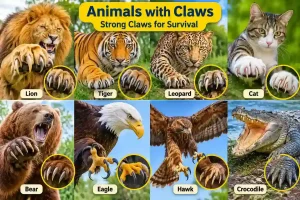
A lion uses its sharp claws to hold prey. A bear uses its strong claws to dig through soil and find food. A mole has wide front claws that help it make underground tunnels. A sloth uses its long, curved claws to hang from tree branches. Birds of prey, such as eagles and owls, have special claws called talons that help them catch animals.
Not all claws look the same. Some are long and curved, while others are short, thick, or sharp. Some animals can pull their claws back into their paws, while others keep them outside their feet. Water animals such as crabs and lobsters also have claw-like body parts called pincers.
This complete guide explores animals with claws, their names, types, uses, habitats, and special features. It also covers small animals with claws, domestic animals, sea animals, animals with sharp teeth, animals with talons, and animals that use their claws for digging, climbing, hunting, and defense.
What Are Claws?

Claws are hard, pointed structures found at the ends of the toes of many animals. They are usually made mainly of keratin, a strong protein also found in hair, feathers, and human fingernails.
A claw has a hard outer covering that protects the end of the toe. Its shape can be straight, curved, pointed, or broad. The shape often depends on how an animal lives and what it needs to do.
For example, a cat has curved claws that help it climb and catch prey. A mole has wide claws that help it push soil away. A bear has strong claws that help it dig and search for food.
Animals use claws for several important reasons:
- Catching and holding prey
- Climbing trees and rocks
- Digging holes and tunnels
- Gripping the ground
- Opening food
- Holding objects
- Protecting themselves
- Grooming their bodies
- Moving across rough surfaces
Claws are not only useful for hunting animals. Plant-eating animals, small animals, and prey animals also depend on their claws to survive.
Animals with Claws List
Many mammals, birds, reptiles, and other animals have claws. Some have sharp claws for hunting, while others have strong claws for climbing or digging.
Here is a list of animals with claws and their main uses.
| Animal | Scientific Name | Main Use of Claws |
| Lion | Panthera leo | Hunting and defense |
| Tiger | Panthera tigris | Holding prey |
| Leopard | Panthera pardus | Climbing and hunting |
| Jaguar | Panthera onca | Gripping and catching prey |
| Snow Leopard | Panthera uncia | Climbing rocky slopes |
| Cheetah | Acinonyx jubatus | Gripping the ground |
| Cougar | Puma concolor | Hunting and climbing |
| Eurasian Lynx | Lynx lynx | Catching prey |
| Domestic Cat | Felis catus | Climbing and catching small animals |
| Grizzly Bear | Ursus arctos horribilis | Digging and finding food |
| Polar Bear | Ursus maritimus | Walking on ice and catching prey |
| Wolverine | Gulo gulo | Digging and gripping |
| Honey Badger | Mellivora capensis | Digging and defense |
| Sloth Bear | Melursus ursinus | Opening insect nests |
| Red Fox | Vulpes vulpes | Digging and catching food |
| Gray Wolf | Canis lupus | Gripping the ground |
| Giant Anteater | Myrmecophaga tridactyla | Opening ant and termite nests |
| Giant Armadillo | Priodontes maximus | Digging deep holes |
| American Badger | Taxidea taxus | Digging underground homes |
| Star-Nosed Mole | Condylura cristata | Digging tunnels |
| Meerkat | Suricata suricatta | Digging burrows |
| Three-Toed Sloth | Bradypus variegatus | Hanging from branches |
| Koala | Phascolarctos cinereus | Climbing trees |
| Raccoon | Procyon lotor | Climbing and handling food |
| Harpy Eagle | Harpia harpyja | Catching prey |
| Bald Eagle | Haliaeetus leucocephalus | Catching fish and animals |
| Golden Eagle | Aquila chrysaetos | Holding prey |
| Great Horned Owl | Bubo virginianus | Catching small animals |
| Osprey | Pandion haliaetus | Gripping fish |
| Nile Monitor Lizard | Varanus niloticus | Climbing and digging |
| Komodo Dragon | Varanus komodoensis | Gripping and digging |
| Southern Cassowary | Casuarius casuarius | Movement and defense |
| Alligator Snapping Turtle | Macrochelys temminckii | Digging and moving |
| Pangolin | Manidae | Digging for insects |
| Sea Otter | Enhydra lutris | Holding food |
| Crab | Various species | Grabbing food with pincers |
| Lobster | Various species | Crushing food with pincers |
| Crayfish | Various species | Holding food and defense |
This list includes animals from different groups. Their claws may look similar, but their size, shape, and purpose can be very different.
Different Types of Claws in Animals
Animal claws come in many shapes and sizes. Their structure often matches the animal’s habitat, diet, and behavior.
Sharp Claws
Sharp claws have pointed tips. They help animals grip surfaces, catch prey, and protect themselves.
Cats have sharp claws that help them climb and catch small animals. Tigers and leopards use their claws to hold prey during hunting.
Birds of prey also have sharp claws called talons. Eagles, hawks, and owls use their talons to catch and hold food.
Sharp claws can be useful for both hunting and defense. However, not every animal with sharp claws is a predator.
Long Claws
Long claws help animals perform special tasks such as digging, climbing, and holding food.
The giant anteater has long front claws that help it open ant and termite nests. The giant armadillo has large claws that help it dig through hard soil.
Sloths have long, curved claws that allow them to hang from tree branches. The cassowary has a long, sharp claw on the inner toe of each foot.
Long claws can be useful, but their shape and strength matter more than length alone.
Curved Claws
Curved claws bend inward and help animals grip surfaces or hold food.
Cats have curved claws that help them climb trees and catch prey. Eagles and owls have curved talons that help them hold animals firmly.
Sloths also have curved claws. Their claws allow them to hang from branches for long periods without using much energy.
Retractable Claws
Retractable claws can move back into an animal’s paw when they are not needed. This helps protect the sharp tips from wearing down.
Many members of the cat family have retractable claws.
Examples include:
- Domestic cats
- Lions
- Tigers
- Leopards
- Cougars
- Bobcats
- Snow leopards
A cat usually keeps its claws pulled back while walking or resting. It extends them when climbing, playing, or catching something.
The movement of retractable claws involves the bones, joints, and soft tissues of the toes. It is not simply a matter of the animal choosing to hide a nail.
Non-Retractable Claws
Non-retractable claws stay outside the feet and cannot be fully pulled back into the paws.
Dogs, bears, wolves, foxes, and many digging animals have claws that remain visible.
These claws help animals grip the ground, dig, and move across different surfaces. They may become shorter through normal wear as the animal walks and runs.
Semi-Retractable Claws
Some animals have claws that can move only part of the way back.
The cheetah is a well-known example. Its claws are only partly retractable compared with those of many other cats.
This feature helps the cheetah grip the ground while running. Its special dewclaw on the front foot can also help it hook and control prey during a chase.
Animals with Retractable Claws
Retractable claws are especially useful for animals that need sharp tips for climbing and catching prey.
Domestic cats are familiar examples. They pull their claws back when walking and extend them when needed.
Lions and tigers have retractable claws that help them hold prey during hunting. Leopards use their claws to climb trees and carry food to safer places.
Cougars use their claws for gripping, climbing, and hunting. Snow leopards use their claws to move across steep and rocky mountain areas.
Retractable claws help protect the tips from constant contact with the ground. This can help keep them sharp for important tasks.
Animals with Non-Retractable Claws
Many animals cannot fully hide their claws. These claws help them perform everyday tasks.
Dogs use their claws to grip the ground when walking and running. Their claws also help them dig.
Bears have strong claws that help them dig for roots, insects, and other food. Grizzly bears are especially known for their long front claws.
Wolves use their claws for traction on different surfaces. Foxes use their claws to dig and catch small animals.
Moles have powerful front claws that help them move soil. Badgers use their strong claws to make underground homes.
Animals with the Longest Claws
Some animals are famous for having very long claws. These structures help them find food, climb, or protect themselves.
Giant Armadillo
The giant armadillo has extremely large front claws. It uses them to dig deep holes and open insect nests.
Giant Anteater
The giant anteater has long, strong front claws. It uses them to break into ant and termite nests. It then collects insects with its long tongue.
Sloth
Sloths have long, curved claws that help them hang from tree branches. Their claws are important because they spend much of their lives in trees.
Cassowary
The southern cassowary has a long, sharp claw on the inner toe of each foot. Its powerful legs and feet can help it defend itself.
Harpy Eagle
The harpy eagle has large, strong talons. It uses them to catch and hold animals in forest habitats.
There is no single answer to which animal has the longest claws. The result depends on how the claws are measured and whether their length is compared with body size.
Animals with Powerful Claws
Some animals have strong claws that help them complete difficult tasks.
The grizzly bear has powerful front claws that help it dig through soil and find food. It can also use them to uncover roots and insects.
The giant anteater uses its strong claws to open hard insect nests. These claws help it reach ants and termites that are hidden inside.
The wolverine has strong feet and claws that help it move through snow and dig for food. It is a tough animal that lives in cold regions.
The honey badger has powerful front claws that help it dig burrows and search for food. It can also use its claws when defending itself.
The harpy eagle has strong feet and curved talons. These help it hold prey while flying or feeding.
Small Animals with Claws
Not all animals with claws are large or dangerous. Many small animals use their claws to climb, dig, and find food.
Squirrels
Squirrels have small, curved claws that help them grip tree bark. These claws make it easier for them to climb and move between branches.
Mice
Mice have tiny claws on their feet. These help them climb, hold onto surfaces, and move through narrow spaces.
Rats
Rats use their claws to climb, dig, and hold food. Their feet help them move through different environments.
Geckos
Many geckos have small claws on their toes. Some species also have special toe pads that help them climb smooth surfaces.
Ants
Ants have small claws at the ends of their feet. These help them grip leaves, soil, and other surfaces.
Beetles
Many beetles have small claws that help them hold onto plants and branches. These structures are useful when they climb or move around.
Star-Nosed Mole
The star-nosed mole is a small mammal with strong front feet and claws. It uses them to dig through wet soil and make underground tunnels.
Its nose has many small, sensitive tentacles that help it find food. These tentacles are not claws, but they are an important part of its unusual body.
Domestic Animals with Claws

Many animals that live with people have claws or nails.
Dogs have claws that help them grip the ground, walk, run, and dig. Their claws grow throughout life and may need trimming if they do not wear down naturally.
Cats have sharp, retractable claws. They use them for climbing, stretching, playing, and catching small animals.
Pet rabbits have strong nails that help them dig. Their nails need regular care because they can become too long.
Hamsters have small claws that help them move and climb. Guinea pigs also have nails that need proper care.
Pet birds have claws on their feet. These help them grip branches and perches.
Domestic animals need suitable living conditions and regular care to keep their feet and claws healthy.
Land Animals with Claws
Many land animals use their claws to move, hunt, dig, and protect themselves.
Lions and tigers use their claws for hunting. Bears use them for digging and finding food. Foxes and wolves use their claws for grip and movement.
Moles and badgers use their claws to make underground tunnels. Sloths and koalas use their claws to climb trees.
Reptiles such as monitor lizards and geckos also have claws. They use them to grip rocks, climb trees, and move across different surfaces.
The claws of land animals often match the type of ground and habitat where they live.
Prey Animals with Claws
Many people think only hunting animals have claws. However, prey animals also have them.
Prey animals are animals that may be hunted by other animals. Their claws can help them escape, dig hiding places, climb, or protect themselves.
Rabbits have claws that help them dig burrows. These underground homes provide shelter from predators and bad weather.
Squirrels use their claws to climb trees and escape danger. Mice use their small claws to climb and hide in narrow spaces.
Armadillos use their strong claws to dig holes. These holes can provide shelter and help them find insects.
Meerkats use their claws to dig underground burrows. These homes help protect their groups from danger and harsh weather.
Deer are different because they have hooves rather than typical claws. Their hooves help them run quickly and escape predators.
Claws are useful for both hunters and animals that need to avoid being hunted.
Animals with Claws and Fangs
Some animals have both claws and sharp teeth called fangs or canine teeth. These body parts work together during hunting and feeding.
Lions have strong paws, sharp claws, and large canine teeth. Their claws help hold prey, while their teeth help them bite.
Tigers have powerful legs, sharp claws, and strong teeth. They use these body parts to catch and eat prey.
Leopards use their claws to grip prey and climb trees. Their teeth help them eat meat.
Wolves use their claws for grip and their teeth to catch and eat food.
Foxes have claws for digging and teeth for catching small animals.
Jaguars have powerful jaws, sharp teeth, and strong paws. Their claws help them grip prey during a hunt.
Not every animal with claws has fangs. Claws and teeth are different body parts with different jobs.
Animals with Claws and Talons
Claws and talons are related structures, but the words are commonly used for different groups of animals.
Claws are found in mammals and reptiles, such as cats, bears, dogs, and lizards.
Talons are the strong, curved claws found on birds of prey. Eagles, hawks, falcons, and owls have talons.
Birds use their talons to catch, hold, and sometimes kill prey. An eagle’s talons help it grip fish and other animals.
An owl uses its sharp talons to catch mice and other small animals. A hawk uses its talons to hold prey while feeding.
Talons are a special kind of claw adapted for the hunting needs of birds of prey.
Birds with Sharp Talons

Birds of prey have strong feet and sharp talons. These structures help them catch and hold food.
Harpy Eagle
The harpy eagle lives in tropical forests of Central and South America. It has large feet and powerful talons that help it catch animals living in trees.
Bald Eagle
The bald eagle is found in North America. It uses its strong talons to catch fish, birds, and small mammals.
Golden Eagle
The golden eagle is a powerful bird of prey. It uses its talons to hold animals such as rabbits and other small mammals.
Great Horned Owl
The great horned owl has strong feet and curved talons. It uses them to catch birds, rodents, and other small animals.
Osprey
The osprey is a fish-eating bird of prey. Its feet have rough surfaces and curved talons that help it grip slippery fish.
African Fish Eagle
The African fish eagle lives near lakes, rivers, and other water sources in Africa. It uses its talons to catch fish.
Secretary Bird
The secretary bird is a large African bird with long legs. It mainly uses its strong feet to strike and catch prey on the ground. It also has claws on its toes.
Animals with Claws Like Crab
Crabs have two pincers that look like claws. These body parts help them grab food, crush hard shells, and defend themselves.
Other animals also have claw-like pincers.
Lobster
Lobsters have large pincers. Some species have one larger crusher claw and one smaller cutter claw. These help them break food and handle prey.
Crayfish
Crayfish are freshwater animals that look like small lobsters. They have pincers that help them hold food and protect themselves.
Hermit Crab
Hermit crabs use their claws to handle food and protect their soft bodies. They also use empty shells as homes.
Fiddler Crab
Male fiddler crabs have one very large claw and one small claw. They use the large claw to communicate and attract mates.
Coconut Crab
The coconut crab is a large land crab related to hermit crabs. It has powerful pincers that help it break hard food, including coconuts.
Scorpion
Scorpions have two front pincers that help them hold prey. They also have a tail with a stinger.
Scorpion pincers, crab pincers, and mammal claws are not exactly the same. They are different structures that perform similar gripping tasks.
Sea Animals with Claws
Some sea animals have claws or pincers that help them catch food and protect themselves.
Crabs are among the best-known sea animals with pincers. They use them to pick up food, break shells, and defend themselves.
Lobsters have strong pincers that help them crush food. Some also use their smaller claws to handle food.
Some shrimp have small claw-like structures that help them catch and hold food.
Sea otters are marine mammals, not crustaceans. They have small claws on their front paws that help them hold food and handle objects while floating in water.
Not all sea animals have claws. Fish, dolphins, whales, and sharks do not have the same type of claws found in crabs or mammals.
Aquatic Animals with Claws
Aquatic animals live in water for all or most of their lives. Some have claws or pincers that help them survive in rivers, lakes, and oceans.
Crayfish live in freshwater and have pincers for holding food and defense.
Lobsters live in the sea and use their claws to crush or handle food.
Crabs live in oceans, coastal areas, and some freshwater habitats. Their pincers help them feed and protect themselves.
Some freshwater prawns have small claw-like structures that help them hold food.
Sea otters use their front paws and claws to handle food. They can hold shellfish and other items while floating on their backs.
These animals show how different body structures help animals survive in water.
Marine Animals with Claws That Act Like Pincers

Marine animals live in saltwater habitats such as oceans and seas.
Many crabs, lobsters, and some shrimp have pincers or claw-like structures. These structures help them hold food, break shells, and protect themselves.
The lobster uses its pincers to handle and crush food. Crabs use their pincers to collect food and defend themselves.
The coconut crab is related to hermit crabs, but adult coconut crabs live on land rather than in the sea. It is famous for its powerful pincers.
The shape and size of pincers can differ between species. Their structure is adapted to the type of food and habitat of each animal.
Animals with Claws for Digging
Many animals use their claws to dig holes, find food, or build safe homes.
Mole
Moles have broad front feet with strong claws. They push soil away to create underground tunnels.
Star-Nosed Mole
The star-nosed mole lives in wet soil and areas near water. It uses strong front claws to dig tunnels and search for small animals.
American Badger
The American badger has powerful front claws. It uses them to dig burrows and catch animals living underground.
Giant Armadillo
The giant armadillo has large front claws. It uses them to dig deep holes and search for ants and termites.
Giant Anteater
The giant anteater uses its long claws to break open insect nests. It then collects ants and termites with its long tongue.
Rabbit
Rabbits use their claws to dig burrows. These underground homes help protect them from predators and bad weather.
Prairie Dog
Prairie dogs use their front feet and claws to dig underground homes. Their burrows can contain many tunnels and rooms.
Meerkat
Meerkats use their claws to dig for insects and create underground shelters. They often live in groups and use burrows for safety.
Animals That Climb with Claws
Claws help many animals climb trees, rocks, and other surfaces.
Leopards have sharp claws that help them climb trees. They may carry prey into a tree to keep it away from other animals.
Squirrels use small claws to grip tree bark. Their flexible bodies also help them move between branches.
Koalas have strong, curved claws that help them climb eucalyptus trees. They use their feet to hold onto tree trunks.
Sloths have long claws that allow them to hang from branches. They spend much of their time in trees.
Raccoons use their claws and flexible paws to climb and handle objects.
Geckos can climb many surfaces. Some use tiny claws, while others rely heavily on special toe pads that help them stick to smooth surfaces.
The Nile monitor lizard uses its strong claws to climb, dig, and move across different surfaces.
Animals That Fight with Claws
Claws can be used during fights between animals. They may help an animal protect itself, compete for space, or defend its young.
Lions sometimes use their claws during fights with other lions. Tigers can use their strong paws and claws when defending themselves.
Bears may use their claws when they feel threatened. However, they often try to avoid danger when possible.
Cats use their claws during play and fights. Their claws can help them hold onto an opponent or escape.
Cassowaries have powerful legs and sharp toe claws. They can use their feet to defend themselves when threatened.
Wolverines and honey badgers also have strong claws that help them dig and defend themselves.
Not all animals fight with claws. Some use teeth, horns, antlers, pincers, or other body parts.
Animals with Claws on Their Feet

Many animals have claws at the ends of their toes. These claws help them grip the ground, climb, dig, and catch food.
Cats have sharp claws on their paws. Dogs have nails that help them grip surfaces.
Birds have claws on their toes. Birds of prey have special talons that help them catch animals.
Lizards often have claws on their toes. These help them climb rocks, trees, and other surfaces.
Crabs have pincers on their front limbs, which they use to grab and crush food.
The shape and position of claws can tell us a lot about how an animal lives.
Animals with Hooves
Hooves are hard coverings found at the ends of the toes of certain animals. They are not the same as claws, even though both are made mainly of keratin.
Animals with hooves include:
- Horses
- Cows
- Goats
- Sheep
- Deer
- Zebras
- Donkeys
- Pigs
- Wildebeest
- Buffalo
Horses use their hooves to run and support their body weight. Goats use their split hooves to climb rocky areas. Deer use their hooves to move quickly through forests and open land.
Some hoofed animals also have dewclaws. These are small extra digits higher up on the legs. They should not be confused with the main hooves.
Hooves are adapted for movement and weight support, while claws often help with gripping, digging, climbing, and catching food.
Difference Between Claws, Talons, Nails, Hooves, and Pincers
These body parts may look similar, but they have different shapes and uses.
| Body Part | Common Animals | Main Function |
| Claws | Cats, bears, lizards | Climbing, digging, and gripping |
| Talons | Eagles, hawks, owls | Catching and holding prey |
| Nails | Primates and some other mammals | Protecting the ends of toes |
| Hooves | Horses, cows, goats | Supporting weight and movement |
| Pincers | Crabs, lobsters, scorpions | Grabbing, crushing, and holding |
Claws are usually pointed and curved. Talons are specialized claws found on birds of prey. Nails are generally flatter than claws. Hooves protect the ends of the toes and support the animal’s weight. Pincers are paired gripping structures that close together.
These differences are important when studying animal anatomy and how different animals use their feet.
How Animal Claws Grow
Claws grow from a living area near their base. New material forms and pushes the older material outward.
In many animals, claws continue to grow throughout life. Walking, climbing, digging, and scratching can wear them down naturally.
Cats scratch surfaces to help remove old outer layers from their claws. Dogs may wear down their nails by walking and running on rough ground.
Pet animals sometimes need nail trimming because their claws may not wear down enough through normal activity.
The growth and structure of claws can vary between mammals, birds, and reptiles.
What Are Claw Sheaths?
A claw sheath is the hard outer covering of a claw. It protects the end of the toe and helps the animal grip or hold objects.
In cats, the outer layers of the claws can become worn or shed. Scratching helps remove these old layers and exposes sharper surfaces underneath.
The shape and thickness of a claw sheath can differ between animals. A climbing animal may have a different claw shape from an animal that spends much of its time digging.
How Do Flexor Tendons Help Animals Use Their Claws?
Flexor tendons are strong tissues that connect muscles to bones. They help animals bend their toes and control their feet.
In animals with specialized claws, muscles, tendons, joints, and bones work together to move the toes and claws.
Cats use this system to extend their claws when needed. They can keep their claws retracted during much of their normal movement.
This movement is a good example of how animal anatomy supports special behaviors such as climbing and hunting.
What Are Paw Pads?
Paw pads are soft areas on the bottom of the feet of many mammals. They help protect the feet and provide grip.
Cats, dogs, bears, and many other mammals have paw pads.
Paw pads help absorb pressure when animals walk, run, jump, or land. They also work with the claws to support movement.
For example, a cat uses its paw pads for quiet movement and its claws for gripping and climbing.
Why Do Animals Have Different Claw Shapes?

Animals have different claw shapes because they live in different habitats and perform different tasks.
A cat has curved claws for climbing and catching prey. A mole has broad claws for moving soil. A sloth has long claws for hanging from branches.
Birds of prey have curved talons for holding prey. Crabs have pincers for grabbing and crushing food.
The environment also affects the way claws are used. Animals living in trees need good gripping ability. Animals living underground need strong digging structures.
These features are examples of physical adaptations that help animals survive.
Animals with Claws in Hawaii
Hawaii has many native and introduced animals. Some animals found there have claws, while others have claw-like feet or gripping structures.
Hawaiian geckos have small claws that help them grip surfaces. They can climb walls, rocks, and plants.
Many birds in Hawaii have claws on their feet. These help them hold branches and move around.
Crabs live along Hawaiian shores and use their pincers to collect food and protect themselves.
The Hawaiian monk seal has nails on its front flippers. These are not typical mammal claws, but they help it interact with its surroundings.
Hawaii has many unique species, so protecting their natural habitats is important.
Animals with Claws in Red Dead Redemption 2
Red Dead Redemption 2, also called RDR2, is a popular open-world video game. It includes many animals that players can find, hunt, and study.
Some animals in the game have claws or talons, just like their real-world counterparts.
Examples include:
- Bears
- Wolves
- Cougars
- Panthers
- Bobcats
- Foxes
- Eagles
- Hawks
- Owls
Bears and big cats have claws that help them hunt and protect themselves. Eagles and other birds of prey have talons for catching animals.
The animals in RDR2 are based on real wildlife, although the game may simplify some animal details for gameplay.
Animals with Claws and Their Habitats
Claws are found in many different environments. Each habitat provides different challenges, and animals use their claws in ways that help them survive.
Tropical Rainforests
Tropical rainforests are home to animals such as jaguars, harpy eagles, sloths, and giant anteaters.
Jaguars use their claws to grip prey. Harpy eagles use talons to catch animals. Sloths use curved claws to hang from branches.
Grasslands and Savannas
Lions, foxes, honey badgers, and many birds of prey live in grasslands and savannas.
Lions use claws during hunting. Honey badgers use theirs to dig. Birds of prey use talons to catch small animals.
Mountains and Rocky Areas
Snow leopards, golden eagles, and some bears live in mountain regions.
Snow leopards use wide paws and strong claws to move across rocky slopes. Golden eagles use their talons to catch prey.
Arctic and Snowy Regions
Polar bears live in Arctic areas. They use their claws to grip ice, move across snow, and catch prey.
Wolverines live in cold northern regions. Their claws help them dig through snow and search for food.
Rivers and Wetlands
Crayfish, freshwater crabs, and some turtles live in rivers and wetlands.
They use pincers or claws to handle food, move through their habitats, and protect themselves.
Coastal Areas and Oceans
Crabs, lobsters, and sea otters live in coastal and marine environments.
Crabs and lobsters use pincers, while sea otters use their front paws and claws to handle food.
Claws and Animal Behavior

Claws do more than help animals move. They can also play a role in communication and behavior.
Some cats scratch trees and other surfaces. This can leave visible marks and scent signals.
Some animals use their claws to mark territory. This can help show other animals that an area is already being used.
Claws also help animals groom themselves. Some animals use their feet and claws to remove dirt or reach parts of their bodies.
Different species use claws in different ways. These behaviors are part of their natural survival strategies.
Claws and Animal Evolution
Claws are physical structures that developed over a long period of animal evolution.
Natural selection can help explain why animals have different claw shapes. Animals with body structures that work well in their environments may have a better chance of surviving and producing young.
For example, animals that climb trees may benefit from claws that provide a strong grip. Animals that dig underground may benefit from wide and powerful claws.
Over many generations, useful features can become more common in a population.
This process helps explain why animals have such different claws today.
Claws and Animal Biomechanics
Animal biomechanics is the study of how body parts work during movement.
Claws play an important role in biomechanics because they help animals grip, push, pull, and hold objects.
A mole uses its front claws to move soil. A cat uses its claws to grip a tree. An eagle uses its talons to hold prey.
The size, curve, and position of claws can affect how much force an animal can apply.
Scientists study these features to understand how animals move and how their bodies are adapted to different tasks.
How Claws Support Ecosystems
Animals with claws play important roles in their ecosystems.
Digging animals such as moles, badgers, and armadillos move soil while making tunnels. This can change the structure of the ground and create spaces used by other animals.
Predators such as lions, leopards, and eagles help control the populations of prey animals.
Anteaters eat ants and termites, helping affect insect populations. Scavengers and other wildlife also help move nutrients through natural environments.
Healthy ecosystems depend on many different species. Protecting habitats helps support biodiversity and the balance of nature.
Animal Conservation and Claw-Bearing Species
Many animals with claws face threats such as habitat loss, hunting, pollution, and climate change.
Snow leopards need healthy mountain habitats. Harpy eagles depend on large areas of tropical forest. Jaguars need connected habitats where they can find food and shelter.
Polar bears are affected by changes in Arctic sea ice. Sea otters can be harmed by pollution and changes in coastal environments.
Conservation work helps protect these animals and their habitats. National parks, wildlife reserves, research, and responsible land use can support animal survival.
Interesting Facts About Animals with Claws

- Cats can pull their claws back into their paws.
- Cheetahs have partly retractable claws that help them grip the ground.
- Bears use their claws to dig and search for food.
- Sloths use long claws to hang from tree branches.
- Moles have strong front claws for digging tunnels.
- Star-nosed moles use sensitive nose tentacles to find food.
- Eagles use talons to catch and hold prey.
- Ospreys have special feet that help them grip slippery fish.
- Crabs use pincers to handle food and defend themselves.
- Coconut crabs have powerful pincers.
- Honey badgers use their claws to dig.
- Koalas use strong claws to climb eucalyptus trees.
- Geckos use claws or special toe pads to climb.
- Many prey animals have claws that help them escape danger.
- Claws are mainly made of keratin.
- Hooves and claws are different body structures.
- Some animals use their claws for grooming and territorial marking.
Frequently Asked Questions
Animals with claws are animals that have hard structures at the ends of their toes. Cats, dogs, bears, lizards, and many birds have claws or special claw-like structures.
Cats, tigers, leopards, eagles, and owls have sharp claws or talons. There is no single winner because sharpness can be measured in different ways.
Lobsters, crayfish, hermit crabs, fiddler crabs, and coconut crabs have pincers that look like claws. Scorpions also have front pincers.
Mice, squirrels, geckos, beetles, ants, and small crabs have claws or claw-like structures. They use them for gripping, climbing, digging, or holding food.
Yes. Cats, dogs, rabbits, hamsters, and many pet birds have claws or nails. These help them move, climb, dig, and hold objects.
No. Many plant-eating animals also have claws. Sloths, koalas, squirrels, and rabbits use their claws for climbing, gripping, or digging.
Claws are found in many mammals and reptiles. Talons are strong, curved claws found on birds of prey, such as eagles, hawks, and owls.
No. Hooves are hard coverings that protect the ends of an animal’s toes and support its body weight. Claws are usually pointed structures used for gripping, climbing, digging, or catching food.
Many crabs and lobsters have pincers. Crayfish live in freshwater and also have pincers. Some other aquatic animals have small claw-like structures.
Moles, badgers, armadillos, giant anteaters, rabbits, and prairie dogs use their claws or strong nails to dig holes and tunnels.
Leopards, squirrels, koalas, sloths, and many lizards use claws to climb trees, rocks, or other surfaces. Some geckos also use special toe pads.
Claws grow throughout the lives of many animals. Some animals can repair or replace damaged claws over time, but the process depends on the species and the type of injury.
Cats can pull their claws back to protect the sharp tips from constant contact with the ground. They extend their claws when climbing, catching prey, or defending themselves.
Yes. Birds have claws on their toes. Birds of prey such as eagles, hawks, and owls have strong, curved claws called talons.
Having claws does not automatically make an animal halal or haram to eat. Islamic dietary rules depend on the type of animal and other religious guidelines. Some scholars discuss animals of prey with fangs and birds of prey with talons separately. For a clear ruling about a specific animal, ask a qualified Islamic scholar and follow the guidance of your school of thought.
Final Thoughts
Animals with claws are found on land, in water, in forests, and in many other habitats. Their claws come in different shapes and sizes because each animal has different needs.
Some animals use sharp claws to catch prey. Others use long claws to climb trees or strong claws to dig underground homes. Birds of prey have special talons, while crabs and lobsters use pincers to hold and crush food.
Claws are not only found in dangerous hunters. Small animals, plant-eaters, and prey animals also use them to survive. The star-nosed mole, giant anteater, honey badger, wolverine, snow leopard, and many other animals show how useful these body parts can be.
By learning about animals with claws, we can better understand animal anatomy, behavior, evolution, and survival. Every claw has a purpose, and each animal has special features that help it live in its natural environment.

Owen Parker writes about animals, wildlife, behavior, habitats, physical traits, and interesting species facts. He enjoys researching animal topics and explaining them in simple, clear language that is easy for everyone to understand.