Skip to content

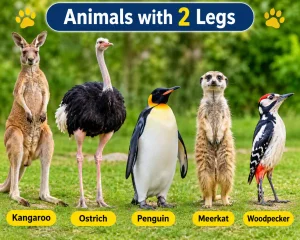
Animals with 2 legs are found in different parts of the world. Birds are the most common examples, but some mammals and reptiles can also move on two legs. Ostriches, penguins, flamingos, kangaroos, and humans are a few examples. These animals have different body shapes, habitats, and ways of moving. Some walk and run, while others hop or stand upright. Scientists use the word bipedalism to describe movement on two legs. Learning about these animals helps us understand animal anatomy, natural selection, evolution, and how living things adapt to their environments.
What Are Animals With 2 Legs?
Animals with two legs are animals that use two legs for walking, running, standing, or hopping. They are often called bipeds.
Most birds have two legs. They use their feet to walk, search for food, climb, swim, and balance their bodies. Some mammals, such as kangaroos and humans, also use two legs for normal movement.
Animals with two legs live in many places, including forests, deserts, grasslands, wetlands, and tropical rainforests. Their body structures help them survive in different environments.

What Does Bipedal Mean?
Bipedal means using two legs for movement. An animal that moves on two legs is called a biped.
Humans are habitual bipeds because they normally walk on two legs. Ostriches and emus are also habitual bipeds. Kangaroos use their two strong back legs for hopping.
Some animals are occasional bipeds. This means they usually move on four limbs but sometimes stand or walk upright. Gorillas, chimpanzees, bonobos, and orangutans are examples.
Bipedal locomotion is an important subject in evolutionary biology because it shows how animals develop different ways to move.
List of Animals With 2 Legs
Here is a list of animals with two legs:
- Ostrich
- Penguin
- Flamingo
- Peacock
- Chicken
- Duck
- Goose
- Turkey
- Emu
- Cassowary
- Kiwi
- Parrot
- Eagle
- Pigeon
- Macaw
- Roadrunner
- Secretary Bird
- Kangaroo
- Wallaby
- Jerboa
- Kangaroo Rat
- Basilisk Lizard
- Gorilla
- Chimpanzee
- Bonobo
- Orangutan
- Human
Most birds normally use two legs for movement. Some mammals and reptiles can also move on two legs, although their movement patterns are different.
Birds With 2 Legs
Birds are the largest and most familiar group of animals with two legs. Their legs help them walk, run, stand, swim, and find food.
Ostrich
The ostrich is the largest living bird in the world. It lives in African grasslands and open plains. It has two long and powerful legs that help it run quickly. Ostriches cannot fly, but they are excellent runners.
Scientific name: Struthio camelus.
Penguin
Penguins are flightless birds found mainly in the Southern Hemisphere. Emperor penguins live in Antarctica. Penguins have two legs and special wings called flippers that help them swim. They also use their feet to walk and balance on land.
Scientific family: Spheniscidae.
Flamingo
Flamingos are famous for their pink feathers and long legs. They live near wetlands, coastal lagoons, and shallow lakes. They use their long legs to walk through water while searching for food.
Scientific family: Phoenicopteridae.
Peacock
Peacocks are colorful birds known for their beautiful feathers. They have two strong legs that help them walk and search for food.
Chicken
Chickens are common farm birds. They are raised for eggs and meat.
Scientific name: Gallus gallus domesticus.
Duck
Ducks are water birds with two legs and webbed feet. Their webbed feet help them swim in ponds, rivers, and lakes. They can also walk on land and search for food.
Scientific family: Anatidae.
Goose
Geese are large water birds that live near lakes, rivers, and wetlands. They have two legs and webbed feet. They eat grass, seeds, and other plant material.
Scientific tribe: Anserini.
Turkey
Turkeys are large birds found on farms and in the wild. They have two strong legs that help them walk and run. Wild turkeys are native to North America.
Scientific name: Meleagris gallopavo.
Emu
The emu is a large flightless bird from Australia. It has two long legs and can run across open grasslands. Its legs are strong and help it travel over long distances.
Scientific name: Dromaius novaehollandiae.
Cassowary
The cassowary is a large flightless bird found in tropical forests of Australia and New Guinea. It has two powerful legs and strong feet. It mainly eats fruits and other plant material.
Scientific genus: Casuarius.
Kiwi
The kiwi is a small flightless bird from New Zealand. It has two strong legs and a long beak. It uses its beak to find insects and other food on the forest floor.
Scientific genus: Apteryx.
Parrot
Parrots are colorful birds with curved beaks and strong feet. They use their two feet to climb branches, hold food, and balance. Macaws are well-known members of the parrot family.
Scientific order: Psittaciformes.
Eagle
Eagles are powerful birds of prey. They have two strong legs with sharp claws. Their feet help them catch and hold food. Eagles are found in different regions of the world.
Scientific family: Accipitridae.
Pigeon
Pigeons are common birds found in cities, parks, and rural areas. They have two legs that help them walk and search for food. Many pigeons build nests on buildings and trees.
Scientific name: Columba livia.
Roadrunner
The greater roadrunner is a bird that lives in dry areas of North America. It has two legs and can run quickly across the ground. It eats insects, small reptiles, and other small animals.
Scientific name: Geococcyx californianus.
Secretary Bird
The secretary bird is a tall bird found in African grasslands and savannas. It has long legs and spends much of its time walking on the ground. It hunts insects, snakes, and other small animals.
Scientific name: Sagittarius serpentarius.
Wild Animals With 2 Legs

Some wild animals can move on two legs even though they are not birds. Many use their back legs for hopping, running, or standing.
Kangaroo
Kangaroos are famous Australian mammals. They have strong back legs and large feet.Their large tails help them balance their bodies.
Scientific family: Macropodidae.
Wallaby
Wallabies are smaller relatives of kangaroos. They have powerful back legs that help them hop. They live in Australia and nearby islands.
Scientific family: Macropodidae.
Jerboa
Jerboas are small desert mammals with long back legs. They use their strong legs to make quick jumps across sandy areas.
Scientific family: Dipodidae.
Kangaroo Rat
Kangaroo rats are small rodents found in North American deserts. They have long back legs and use them to jump across sandy ground. They mainly eat seeds and can survive in dry environments.
Scientific genus: Dipodomys.
Basilisk Lizard
The basilisk lizard is a reptile found in Central America. Some species can run using their two back legs for short distances. This is why they are sometimes called Jesus Christ lizards.
Scientific genus: Basiliscus.
Pangolin
Pangolins are mammals covered with hard protective scales made of keratin. They mainly eat ants and termites.
Scientific family: Manidae.
Farm Animals With 2 Legs
Many common farm animals with two legs are birds. Farmers raise them for eggs, meat, and other products.
Chickens are among the most common farm birds. They walk on two legs and scratch the ground to find food.
Ducks have webbed feet that help them swim in water.Turkeys are larger farm birds with strong legs.
These birds show how animals with two legs can live in farms and other human-managed environments.
Zoo Animals With 2 Legs
Many zoos keep birds with two legs. These animals help visitors learn about different species and their natural habitats.
Common examples include:
- Ostriches
- Penguins
- Flamingos
- Emus
- Peacocks
- Cassowaries
- Parrots
- Macaws
Some zoo birds walk on land, while others swim or climb. Their bodies have special adaptations that help them survive in their natural environments.
Small Animals With 2 Legs
Not all animals with two legs are large. Some small animals also use their back legs for hopping and movement.
Jerboas are small desert mammals with long back legs. Kangaroo rats use powerful legs to jump across dry land. Kiwis are small flightless birds that use their two legs to search for food.
Animals With 2 Legs and Wings
Many animals with two legs also have wings. Most of these animals belong to the bird group.
Examples include:
- Eagle
- Parrot
- Peacock
- Chicken
- Duck
- Goose
- Flamingo
- Ostrich
- Penguin
- Emu
- Macaw
Ostriches, emus, penguins, cassowaries, and kiwis are flightless birds.
Penguins use their wings as flippers for swimming. Ostriches and emus use their wings for balance and other movements.
Animals With 2 Legs and 2 Arms

Some animals have two legs and two front limbs that work like arms.
Humans are the clearest example. We have two legs and two arms.
These primates use their arms for climbing, holding food, and moving through trees. Their front limbs are adapted differently from human arms.
They use them to swing between tree branches, a movement called brachiation.
Animals That Walk on Two Legs Permanently
Some animals normally use two legs for movement. They are called habitual bipeds.
Examples include:
- Humans
- Ostriches
- Emus
- Penguins
- Chickens
- Flamingos
- Kiwis
- Roadrunners
Animals That Walk on Two Legs Occasionally
Some animals usually move on four limbs but can stand or walk upright for short periods.
Examples include:
- Gorillas
- Chimpanzees
- Bonobos
- Orangutans
- Pangolins
- Basilisk lizards
Gorillas and chimpanzees usually use their hands and feet for movement.
This difference between habitual and occasional bipedal movement is important in understanding animal behavior and evolution.
Animals That Hop on Two Legs
Some animals use hopping instead of ordinary walking. Their strong back legs help them jump from one place to another.
Examples include kangaroos, wallabies, jerboas, and kangaroo rats.
Kangaroos and wallabies use their powerful back legs to travel across grasslands. Jerboas and kangaroo rats use their long hind legs to jump across desert environments.
Hopping is a special form of locomotion that helps these animals move and escape predators.
Animals With Long Legs
Some animals have long legs that help them move through grasslands, wetlands, and open areas.
Examples include:
- Ostrich
- Flamingo
- Secretary bird
- Emu
- Crane
- Stilt
Long legs help birds walk through shallow water, search for food, and move across open land.
Animals With Short Legs
Some animals have short legs compared with their body size. Their legs are adapted to their body shape and lifestyle.
Penguins have short legs that support their bodies while walking. Ducks have short legs and webbed feet that help them swim. Chickens use their legs to walk and scratch the ground.
Different leg lengths help animals adapt to different habitats and types of movement.
Flightless Birds With Two Legs
Flightless birds cannot fly, but they use their two legs for walking, running, swimming, or other movements.
Examples include:
- Ostrich
- Emu
- Penguin
- Cassowary
- Kiwi
- Greater Rhea
- Lesser Rhea
The greater rhea and lesser rhea are flightless birds from South America. They live in open areas and use their strong legs to run.
Flightless birds show how animals can develop different adaptations to survive without flying.
How Do Animals Balance on Two Legs?
Animals use different body features to balance on two legs.
Some important features include:
- Strong leg muscles
- A balanced body position
- Strong feet
- Flexible joints
- A suitable skeletal structure
- A tail for balance in some species
Balance is an important part of bipedal locomotion.
Why Do Some Animals Walk on Two Legs?

Animals move on two legs for different reasons. Their body structures, habitats, and survival needs affect how they move.
Some common reasons include:
- To run across open land.
- To see over tall grass.
- To search for food.
- To keep their front limbs free.
- To climb or reach food.
- To escape predators.
- To move efficiently in their natural habitats.
How Did Bipedal Movement Develop?
Bipedal movement developed through evolution. Over many generations, animals developed different body structures that helped them move in useful ways.
Natural selection is one process that helps explain how these adaptations develop. Animals with useful features may have a better chance of surviving and reproducing in their environments.
Different animal groups developed bipedal movement in different ways. This is an example of convergent evolution, where different groups develop similar features independently.
Animals With 2 Legs and Their Habitats
Animals with two legs live in many environments around the world.
| Animal | Natural habitat | Movement |
| Ostrich | African savannas | Running |
| Penguin | Antarctic and other southern regions | Walking and swimming |
| Kangaroo | Australian grasslands | Hopping |
| Wallaby | Australian forests and grasslands | Hopping |
| Jerboa | Asian and African deserts | Hopping |
| Kangaroo Rat | North American deserts | Hopping |
| Flamingo | Wetlands and coastal lagoons | Walking |
| Emu | Australian grasslands | Running |
| Kiwi | New Zealand forests | Walking |
| Basilisk Lizard | Central American forests | Walking and running |
Each animal has special features that help it survive in its habitat.
What Are 10 Animals With Two Legs?
Here are ten common examples of animals with two legs:
- Ostrich
- Penguin
- Flamingo
- Peacock
- Chicken
- Duck
- Goose
- Turkey
- Emu
- Kangaroo
Most of these animals use two legs as their normal way of moving on land.
What Are 5 Animals With 2 Legs?
Five simple examples are:
- Ostrich
- Penguin
- Chicken
- Kangaroo
- Flamingo
These animals belong to different groups and have different movement styles.
What Are 3 Animals With 2 Legs?
Three easy examples are:
- Human
- Ostrich
- Penguin
All three normally use two legs for movement on land.
Four-Letter Animal Names With 2 Legs
Some short animal names include:
- Kiwi
- Duck
- Dove
These names are useful for children who are learning animal vocabulary and short spelling words.
Animals That Stand on Two Legs
Many animals can stand on two legs. Birds such as ostriches, flamingos, penguins, and chickens regularly stand on their two legs.
Standing on two legs does not always mean an animal normally walks on two legs.
Animals That Cannot Fly
Not all birds can fly. Some birds have special body structures that help them survive without flying.
Examples include ostriches, emus, penguins, cassowaries, and kiwis.
Ostriches and emus use their strong legs to run. Penguins use their flippers to swim. Kiwis use their strong legs to move around forest floors.
Animals That Crawl
Some animals move by crawling instead of walking on legs.
Snakes use their muscles and body scales to move across the ground. Earthworms use body contractions to travel through soil.
These animals have different movement systems from animals that walk on two legs.
Animals That Climb Trees
Some animals are excellent tree climbers. They use their limbs, claws, and strong muscles to move between branches.
Examples include:
- Monkeys
- Squirrels
- Sloths
- Orangutans
- Gibbons
- Chimpanzees
Gibbons use their long arms to swing between branches. Orangutans and chimpanzees use their arms and legs to climb trees and find food.
Animals With Webbed Feet
Webbed feet help some animals move through water. They have skin between their toes that helps them push against water.
Examples include ducks, geese, swans, and some other water birds.
Animals That Live in Deserts
Deserts are dry places where animals need special adaptations to survive.
Examples of desert animals include:
- Jerboa
- Kangaroo Rat
- Camel
- Fennec Fox
- Desert Lizard
- Snake
Jerboas and kangaroo rats use their long back legs to hop across sandy ground. Some desert animals are active at night to avoid extreme daytime heat.
Animals That Live in Grasslands
Grasslands are open areas covered with grasses and a small number of trees.
Animals that live in grasslands include ostriches, zebras, lions, antelopes, and kangaroos.
Ostriches use their long legs to run across African grasslands. Kangaroos move through Australian grasslands by hopping.
What Is the Difference Between Walking and Hopping?

Walking and hopping are two different types of movement.
Walking means moving forward by taking steps with the legs. Chickens, penguins, and ostriches commonly walk on two legs.
Hopping means jumping forward using the back legs. Kangaroos, wallabies, jerboas, and kangaroo rats are good examples.
Which Two-Legged Animal Is the Fastest?
The ostrich is the fastest living bird on land. It can reach speeds of around 70 kilometers per hour under suitable conditions.
Its long legs and powerful muscles help it run quickly across open grasslands.
FAQs
Animals that use two legs for movement are called bipeds. The word bipedal describes movement using two legs.Animals that use two legs for movement are called bipeds. The word bipedal describes movement using two legs.
Yes, living birds normally have two legs. They use their legs for walking, standing, swimming, and other movements.
Eagles, parrots, ducks, chickens, flamingos, ostriches, and penguins are examples of birds with two legs and wings.
Yes, ostriches, kangaroos, wallabies, jerboas, and kangaroo rats are examples of wild animals that move on two legs.
Jerboas and kangaroo rats are small mammals that hop on their two back legs. Small birds, such as kiwis, also have two legs.
Yes, humans normally walk on two legs. Kangaroos and wallabies hop on two back legs, while some primates can walk upright occasionally.
A biped uses two legs for movement, while a quadruped uses four legs. Humans and ostriches are examples of bipeds. Dogs and horses are examples of quadrupeds.
Penguins mainly use their flippers to swim. Their two legs help them walk and stand on land.
Yes, some lizards, including basilisk lizards, can run using their two back legs for short distances.
Kangaroos have strong back legs and large feet that help them hop. Their bodies are adapted for this type of movement.
No. Humans are not the only mammals capable of moving on two legs. Kangaroos and wallabies use two legs for hopping, while some primates can walk upright occasionally.
The ostrich has exceptionally long legs among living birds. Its long legs help it run quickly across open land.
Flightless birds are birds that cannot fly. Ostriches, emus, penguins, cassowaries, and kiwis are examples.
Convergent evolution happens when different groups of animals develop similar features independently. Bipedal movement is one example found in different animal groups.
Animals that normally use four legs for movement are called quadrupeds. Dogs, cats, horses, and lions are common examples.
Final Thought
Animals with 2 legs are found in many different groups and habitats. Learning about bipedalism, animal anatomy, habitats, and evolution helps us understand how animals survive in nature. Every animal has special features that support its movement and way of life.

Owen Parker writes about animals, wildlife, behavior, habitats, physical traits, and interesting species facts. He enjoys researching animal topics and explaining them in simple, clear language that is easy for everyone to understand.