Skip to content

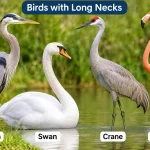
Birds with long necks are some of the most interesting birds in the world. Their long necks help them find food, catch fish, reach plants, and watch for danger. Some birds live near lakes and rivers, while others live in forests, grasslands, and open fields.
You can find birds with long necks in many parts of the world, including Africa, Australia, Europe, Asia, and North America. Some are large birds, such as ostriches and emus. Others are water birds, such as swans, herons, flamingos, and pelicans.
In this guide, you will learn about the names of birds with long necks, their types, habitats, food, and special features. You will also discover rare birds, birds that can fly, birds that cannot fly, and why these birds have long necks.
What Are Birds with Long Necks?

Birds with long necks are birds that have long necks compared with their body size. Their necks help them reach food, catch fish, clean their feathers, and look around for danger.
Some birds have thin and flexible necks. Others have thick and strong necks. A swan can bend its neck to reach plants under the water. A heron can stretch its neck forward to catch a fish. An ostrich uses its long neck to look across open land.
A bird’s neck contains small bones called cervical vertebrae. These bones help the bird bend, turn, and move its head. The number and shape of these bones can be different among bird species.
Names of Birds with Long Necks
There are many types of birds with long necks around the world. Some live near water, while others live on dry land.
Here are some well-known examples:
| Bird Name | Scientific Name | Main Habitat |
| Ostrich | Struthio camelus | African grasslands |
| Greater Flamingo | Phoenicopterus roseus | Lakes and wetlands |
| Mute Swan | Cygnus olor | Lakes and rivers |
| Black Swan | Cygnus atratus | Australian wetlands |
| Great Blue Heron | Ardea herodias | North American wetlands |
| Grey Heron | Ardea cinerea | Europe, Asia, and Africa |
| Great Egret | Ardea alba | Wetlands and marshes |
| Sandhill Crane | Antigone canadensis | Wetlands and grasslands |
| Whooping Crane | Grus americana | North American wetlands |
| Sarus Crane | Antigone antigone | South Asian wetlands |
| Marabou Stork | Leptoptilos crumenifer | African wetlands |
| Dalmatian Pelican | Pelecanus crispus | Lakes and coastal areas |
| Australian Emu | Dromaius novaehollandiae | Australian grasslands |
| Southern Cassowary | Casuarius casuarius | Tropical forests |
| Kori Bustard | Ardeotis kori | African grasslands |
| Oriental Darter | Anhinga melanogaster | Asian wetlands |
| Great Cormorant | Phalacrocorax carbo | Rivers and coastal waters |
| African Spoonbill | Platalea alba | African wetlands |
| Green Heron | Butorides virescens | Wetlands and ponds |
| Florida Limpkin | Aramus guarauna | Florida wetlands |
Birds with the Longest Necks in the World
Some birds have very long necks that help them reach food and see their surroundings. Their necks can look different because each bird has its own way of living.
Ostrich
The ostrich is the tallest living bird. It has a long neck, long legs, and a large body. It lives in parts of Africa and cannot fly. Its height helps it look across open grasslands.
Flamingo
The flamingo has a long, curved neck and long legs. It often stands in shallow water and uses its special bill to filter small food items from the water and mud.
Swan
Swans have long, flexible necks. They use them to reach plants below the water while their bodies float on the surface.
Great Blue Heron
The Great Blue Heron has a long neck and a sharp bill. It often stands still near water before quickly stretching its neck to catch a fish.
Crane
Cranes have long necks and long legs. Many live in wetlands and grasslands. They often fly with their necks stretched forward.
Big Birds with Long Necks
Big birds with long necks are easy to notice because of their height and body size. Some are strong runners, while others are good swimmers or flyers.
Ostrich
The ostrich is a large flightless bird from Africa. It has a long neck, powerful legs, and a small head. It eats plants, seeds, insects, and other small food items.
Australian Emu
The emu is one of the largest birds in the world. It lives in Australia and has a long neck, strong legs, and small wings. It cannot fly but can run across open land.
Southern Cassowary
The Southern Cassowary lives in tropical forests in Australia and New Guinea. It has a strong body, long neck, and a hard helmet-like part on its head called a casque. It eats fruit and other plant and animal food.
Kori Bustard
The Kori Bustard is a large bird found in African grasslands. It spends much of its time walking on the ground. It eats insects, seeds, and small animals.
Marabou Stork
The Marabou Stork is a large African bird with long legs and a long neck. It often feeds on carrion, which means dead animals. It also eats other small animals.
Small Birds with Long Necks

Not all birds with long necks are very large. Some smaller birds also have long, thin necks that help them find food.
Green Heron
The Green Heron is smaller than many other herons. It has a short body, long neck, and sharp bill. It often catches small fish and insects near ponds and streams.
Little Egret
The Little Egret is a slim white bird with a long neck and long legs. It searches for fish and insects in shallow water.
Anhinga
The Anhinga is also called a snakebird because its thin neck can appear above the water while the rest of its body stays underwater. It dives to catch fish.
Black-Necked Stilt
The Black-Necked Stilt has very long legs and a slim body. It walks through shallow water to find small fish and insects.
Birds with Long Necks That Fly
Many birds with long necks can fly. They use their wings to travel between feeding areas, nesting places, and warmer regions.
Examples include:
- Flamingos: They often fly in groups and stretch their necks forward.
- Herons: They usually pull their necks back into an S shape while flying.
- Cranes: They often fly with their necks stretched out.
- Swans: They have large wings and can travel long distances.
- Storks: They have long legs and necks and can fly over wide areas.
- Pelicans: They fly with their long bills and necks held forward.
- Egrets: They are slim water birds that can fly between wetlands.
Birds use different flying styles. Some stretch their necks forward, while others bend them during flight.
Birds with Long Necks and Legs
Some birds have both long necks and long legs. These features help them walk through water, reach food, and move across muddy land.
Flamingos
Flamingos have long legs that help them stand in shallow water. Their long necks help them search for food.
Herons
Herons use their long legs to walk through shallow water. Their flexible necks help them catch fish.
Cranes
Cranes have long legs and long necks. They often feed in wetlands, fields, and grasslands.
Storks
Storks use their long legs to walk through wet areas and find small animals. Their long bills help them pick up food.
Birds with Long Necks and Short Legs
Some birds have long necks but do not have very long legs. Their bodies are often suited to swimming, floating, or feeding in water.
Swans
Swans have long necks and shorter-looking legs. Their legs stay under the water while they swim.
Pelicans
Pelicans have long necks and large bills. Their webbed feet help them swim.
Cormorants
Cormorants have long necks and strong bodies. They dive underwater to catch fish.
The length of a bird’s legs and neck depends on how it lives and finds food.
Water Birds with Long Necks
Water birds with long necks live near lakes, rivers, ponds, marshes, and coastal areas. Many use their necks to find fish and other food in the water.
Common water birds with long necks include:
- Flamingos
- Swans
- Herons
- Egrets
- Pelicans
- Storks
- Cranes
- Darters
- Cormorants
- African Spoonbills
- Limpkins
These birds eat different foods. Some eat fish, while others eat insects, frogs, small water animals, and plants.
White Water Birds with Long Necks
Many white water birds have long necks and long legs. They are often seen near lakes, rivers, and marshes.
Great Egret
The Great Egret is a tall white bird with a long neck and sharp bill. It catches fish and small water animals.
Mute Swan
The Mute Swan is a large white water bird with a long curved neck. It eats water plants and other plant food.
Whooping Crane
The Whooping Crane is a rare white bird from North America. It has a long neck, long legs, and black wing tips.
White Pelican
The White Pelican is a large water bird with a long bill and a throat pouch. It uses its bill to catch and hold fish.
Black Birds with Long Necks
Some dark-colored birds also have long necks. Their feathers may be black, dark brown, or a mix of colors.
Black Swan
The Black Swan lives in Australia and other places where it has been introduced. It has dark feathers, a red bill, and a long neck.
Anhinga
The Anhinga is a water bird with a slim body and long neck. It dives to catch fish.
Great Cormorant
The Great Cormorant is a dark water bird that swims and dives for food. It often rests with its wings spread out to dry.
Marabou Stork
The Marabou Stork has a large body, long legs, and a mostly bare head and neck. It often feeds on carrion.
Duck-Like Birds with Long Necks
Some birds look a little like ducks because they swim on water. However, they may belong to different bird groups.
Magpie Goose
The Magpie Goose lives in Australia and nearby areas. It has a long neck and often feeds on water plants and grass.
Black Swan
The Black Swan swims like a duck but has a much longer neck and a larger body.
Mute Swan
The Mute Swan is a large water bird with a long neck and wide body. It feeds on plants in and around the water.
Great Cormorant
The Great Cormorant swims on the surface and dives below the water to catch fish.
Birds with Long Necks and Beaks
A long neck and a special beak can help a bird find food in many ways. Some birds catch fish, while others pick food from mud or filter it from water.
African Spoonbill
The African Spoonbill has a spoon-shaped bill. It moves its bill through shallow water to find small animals.
Great Blue Heron
The Great Blue Heron has a long, sharp bill for catching fish.
Flamingo
The flamingo has a curved bill that helps it filter small food items from water and mud.
Pelican
The pelican has a large bill with a stretchy throat pouch. The pouch helps it catch and hold fish.
These birds show how the neck and beak work together to help with feeding.
Birds of Prey with Long Necks
Birds of prey hunt other animals for food. Many well-known birds of prey have short or medium-length necks, but some hunting and scavenging birds have longer-looking necks.
Rüppell’s Griffon Vulture
Rüppell’s Griffon Vulture is an African scavenger. It feeds mainly on dead animals. Its bare head and neck help it feed without getting its feathers as dirty.
Secretary Bird
The Secretary Bird is an African bird with long legs and a fairly long neck. It hunts snakes and other small animals while walking on the ground.
Marabou Stork
The Marabou Stork is not a typical bird of prey, but it may eat small animals and carrion.
Rare Birds with Long Necks
Some long-necked birds are rare or face risks in the wild. Their numbers can be affected by habitat loss, pollution, hunting, and changes in their food supply.
Whooping Crane
The Whooping Crane is a rare North American bird. It has a white body, long neck, and long legs. It needs safe wetlands and nesting areas.
Sarus Crane
The Sarus Crane lives in parts of South Asia and Southeast Asia. It is known for its great height, long legs, and long neck.
Black-Necked Stork
The Black-Necked Stork is a large water bird found in parts of Asia and Australia. It searches for fish and other small animals.
Southern Cassowary
The Southern Cassowary lives in tropical forests in Australia and New Guinea. It is important to its forest habitat because it helps spread seeds.
African Birds with Long Necks
Africa has many birds with long necks. Some live in open grasslands, while others live near rivers, lakes, and wetlands.
Examples include:
- Ostrich: A very tall flightless bird that lives in African open areas.
- Greater Flamingo: A pink water bird that feeds in shallow lakes and wetlands.
- Marabou Stork: A large bird that often feeds on carrion.
- Kori Bustard: A heavy ground bird that eats insects, seeds, and small animals.
- African Spoonbill: A water bird with a spoon-shaped bill.
- Rüppell’s Griffon Vulture: A scavenger that feeds on dead animals.
- Grey Heron: A long-necked bird that catches fish and other small animals.
Australian Birds with Long Necks

Australia is home to several birds with long necks. Some are large flightless birds, while others live near water.
Australian Emu
The emu is a large flightless bird with a long neck and strong legs. It lives in many parts of Australia.
Black Swan
The Black Swan is a dark water bird with a long neck and red bill. It can often be seen on lakes and rivers.
Magpie Goose
The Magpie Goose is a water bird that feeds on plants and grass. It is found in northern Australia and nearby areas.
Australian Darter
The Australian Darter is a slim water bird that dives underwater to catch fish.
Southern Cassowary
The Southern Cassowary lives in tropical forests in northeastern Australia and New Guinea.
Asian Birds with Long Necks
Asia has many long-necked birds that live near lakes, rivers, wetlands, and fields.
Sarus Crane
The Sarus Crane is a tall bird found in parts of South Asia and Southeast Asia. It often feeds in wetlands and fields.
Oriental Darter
The Oriental Darter is a water bird with a long, thin neck. It dives to catch fish.
Black-Necked Stork
The Black-Necked Stork is a large bird that searches for food in wetlands.
Grey Heron
The Grey Heron is found across parts of Asia, Europe, and Africa. It uses its long neck and sharp bill to catch fish.
Birds with Long Necks in the UK
The United Kingdom has several birds with long necks. Many can be seen near lakes, rivers, ponds, and marshes.
Examples include:
- Grey Heron
- Mute Swan
- Great Egret
- Little Egret
- Common Crane
- Greylag Goose
These birds use wetland areas to find food, rest, and raise their young.
Birds with Long Necks in South Africa
South Africa has many long-necked birds because it has wetlands, lakes, grasslands, and open habitats.
Some examples are:
- Greater Flamingo
- Ostrich
- Marabou Stork
- African Spoonbill
- Grey Heron
- Kori Bustard
- Rüppell’s Griffon Vulture
Their diets include fish, insects, plants, small animals, and carrion.
Birds with Long Necks in Florida
Florida has many wetlands, ponds, rivers, and coastal areas. These places provide food and shelter for long-necked birds.
Common examples include:
- Great Blue Heron
- Great Egret
- Green Heron
- Florida Limpkin
- Wood Stork
- Anhinga
The Florida Limpkin is known for eating apple snails. Herons and egrets often search for fish in shallow water.
Birds with Long Necks in Texas

Texas has many lakes, rivers, marshes, and open fields. These places attract several long-necked birds.
Examples include:
- Great Blue Heron
- Great Egret
- Sandhill Crane
- Whooping Crane
- White-faced Ibis
- American White Pelican
Some birds stay in Texas all year, while others visit during migration.
Birds with Long Necks in Michigan
Michigan has many lakes, rivers, and wetlands. These habitats support birds that search for food in shallow water.
Examples include:
- Great Blue Heron
- Sandhill Crane
- Trumpeter Swan
- Great Egret
- Double-crested Cormorant
These birds may eat fish, insects, frogs, and other small animals.
Why Do Birds Have Long Necks?
Birds have long necks for many reasons. Their necks help them reach food, catch prey, clean feathers, and look around.
A long neck can help a bird:
- Reach plants under the water.
- Catch fish without moving its whole body.
- Search for food in deep mud.
- Watch for danger from a higher point.
- Clean and arrange its feathers.
- Move its head in different directions.
The neck also works with the bird’s beak. Together, they help birds pick up, hold, and move food.
How Do Birds with Long Necks Catch Fish?
Many water birds use their long necks to catch fish. Herons, egrets, and darters are good examples.
A heron may stand still in shallow water. When a fish comes near, it quickly pushes its head forward and catches the fish with its sharp bill.
An anhinga swims underwater and uses its long neck to reach fish. Pelicans use their large bills and throat pouches to catch and hold fish.
Different birds have different feeding methods. Their necks, bills, and body shapes help them find food in their own way.
How Many Neck Bones Do Birds Have?

Bird neck bones are called cervical vertebrae. They support the head and help the neck move.
Different birds have different numbers of cervical vertebrae. Swans have many neck vertebrae, while other birds have fewer. The shape and length of these bones also matter.
A bird’s neck is not just a long tube. It has bones, muscles, joints, and other soft parts that allow it to bend and move.
How Do Birds with Long Necks Sleep?
Birds sleep in different ways. Some rest with their heads tucked near their backs. Others place their heads on their bodies or keep their necks in a relaxed position.
Swans and flamingos may rest while standing or floating. The way a bird sleeps can depend on its species, habitat, and surroundings.
How Do Long-Necked Birds Keep Their Feathers Clean?
Birds clean their feathers through a process called preening. They use their beaks to arrange feathers and remove dirt.
A long neck helps a bird reach many parts of its body. This is useful for keeping feathers neat and in good condition.
Clean feathers help birds stay warm, protect their skin, and support flight.
Evolution and Adaptations of Long-Necked Birds
Birds developed different neck shapes over a long period of evolution. Their necks changed as they adapted to different ways of finding food and living in different habitats.
For example, herons need flexible necks to catch fish. Swans use their necks to reach plants under water. Flamingos use their necks while feeding in shallow water.
Scientists study bird neck bones, muscles, and movement to understand these adaptations. Natural selection helps explain how useful body features can become more common over many generations.
Are All Birds with Long Necks Able to Fly?
No. Some birds with long necks can fly, while others cannot.
Ostriches, emus, and cassowaries are flightless birds. They have strong legs and use them to walk or run.
Flamingos, herons, cranes, swans, and storks can fly. Their wings help them move between feeding and nesting areas.
What Do Birds with Long Necks Eat?
Birds with long necks eat many types of food. Their diets depend on where they live and how they find food.
Common foods include:
- Fish
- Insects
- Frogs
- Crustaceans
- Small reptiles
- Seeds
- Grasses
- Water plants
- Mollusks
- Small mammals
- Carrion
Flamingos filter small food items from water. Herons catch fish with their sharp bills. Swans eat water plants. Vultures and Marabou Storks may feed on dead animals.
Where Do Birds with Long Necks Live?
Long-necked birds live in many habitats around the world.
Wetlands: Herons, egrets, cranes, and storks often live near wetlands.
Lakes and rivers: Swans, pelicans, cormorants, and flamingos may use lakes and rivers for food and shelter.
Grasslands: Ostriches, emus, and Kori Bustards live in open areas.
Tropical forests: Cassowaries live in tropical forests in Australia and New Guinea.
Coastal areas: Some pelicans, cormorants, and other water birds live near the sea.
These habitats provide food, water, nesting places, and safe areas for birds.
Why Are Some Birds with Long Necks Endangered?
Some long-necked birds face problems in the wild. Their habitats may be damaged by farming, building, pollution, hunting, and changes in their food supply.
Wetland drainage can remove important feeding and nesting places. Water pollution can also harm fish and other animals that birds eat.
Bird conservation helps protect nesting areas, wetlands, forests, and food sources. Keeping rivers and lakes clean can also help water birds survive.
Interesting Facts About Birds with Long Necks

- The ostrich is the tallest living bird.
- Flamingos can stand on one leg while resting.
- Swans use their long necks to reach plants under water.
- Herons often bend their necks into an S shape.
- Anhingas are also called snakebirds because of their thin necks.
- Pelicans have large bills with stretchy throat pouches.
- Cranes often fly with their necks stretched out.
- The emu is a large flightless bird from Australia.
- The African Spoonbill has a spoon-shaped bill.
- The cassowary lives in tropical forests.
- The Great Cormorant dives underwater to catch fish.
- The Whooping Crane is a rare bird from North America.
Birds with Long Necks Crossword Clue
If you are solving a crossword puzzle, the answer depends on the number of letters and the clue.
Some possible bird names include:
- Emu: A large flightless bird.
- Swan: A water bird with a long neck.
- Heron: A bird that catches fish.
- Crane: A tall bird with long legs and a long neck.
- Stork: A large bird with long legs and a long bill.
Always check the number of letters in your crossword before choosing an answer.
Frequently Asked Questions
The flamingo, swan, ostrich, and heron are some of the most famous birds with long necks. They are easy to recognize because of their body shape and long necks.
The ostrich is the tallest living bird. It has a long neck, long legs, and a large body.
Flamingos, swans, herons, cranes, storks, and pelicans can fly. They use their wings to travel between feeding and nesting places.
Yes. Green Herons and some egrets have slim bodies and long necks. They often live near water.
Flamingos use their long necks to reach food in shallow water. Their special bills help them filter small food items.
Great Egrets, Mute Swans, Whooping Cranes, and White Pelicans are examples of white birds with long necks.
Many live near water, but not all. Swans, herons, and pelicans live near water, while ostriches and emus live mainly on land.
The Great Blue Heron has a long neck and a sharp bill. It uses its bill to catch fish and other small animals.
Yes. Ostriches, emus, and cassowaries have long necks but cannot fly.
There is no single name for all birds with long necks. They belong to different bird groups, including herons, cranes, storks, swans, and flamingos.
Flamingos, herons, cranes, storks, and ostriches are examples of birds with long necks and long legs.
Swans and some swimming birds have long necks with legs that look short when their bodies are in the water.
Their food includes fish, insects, frogs, plants, seeds, crustaceans, and small animals. Some birds, such as vultures, also eat carrion.
Final Thoughts
Birds with long necks come in many shapes and sizes. Some are very large, such as ostriches and emus. Others, like herons and egrets, have slim bodies and long necks that help them catch fish.
Their necks help them find food, reach plants, clean their feathers, and stay aware of their surroundings. Many live near water, while others live in forests and grasslands.
Learning about these birds helps us understand how animals adapt to their homes. It also reminds us why we should protect wetlands, forests, lakes, and other natural places.

Owen Parker writes about animals, wildlife, behavior, habitats, physical traits, and interesting species facts. He enjoys researching animal topics and explaining them in simple, clear language that is easy for everyone to understand.